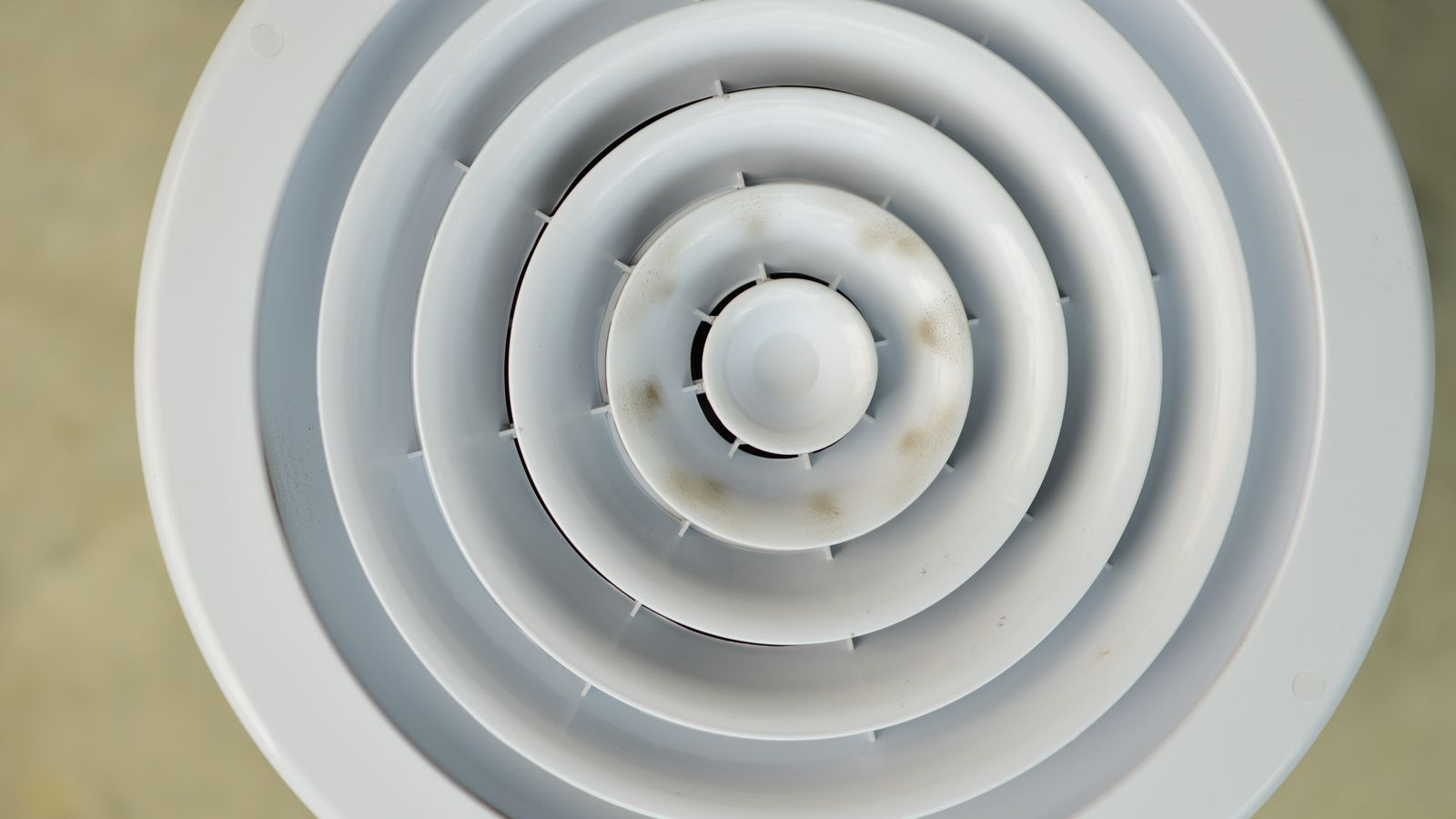
Thirty minutes, not thirty seconds.
Most people switch it off with the light. Health Canada asks for half an hour after the water stops, and for the duct to actually reach outside.


 Licensed technicians
Quick answer
A bathroom exhaust fan removes the water your shower puts into the air before it lands on cold surfaces. Health Canada says one should be installed in each bathroom, used whenever you shower, and left running for at least thirty minutes afterwards. However, it only works if the duct ends outdoors rather than in the attic.
Key takeaways
- Firstly, every bathroom should have one, not just the main one.
- Run it for at least thirty minutes after the water stops.
- The duct must reach outside, never the attic or a roof space.
- Target indoor humidity sits between 30 and 50 percent.
- Above all, a tighter house needs the fan more, not less.
What the fan is really removing
First, the problem. A shower turns several litres of water into vapour in a few minutes.
In fact Health Canada lists the sources: “daily indoor activities such as showering or bathing, washing clothes or cooking.”
Consequently that vapour has to go somewhere. Without extraction it migrates through the house and condenses on the coldest surface it finds.
Meanwhile the department names the failure directly, warning about moisture “particularly if exhaust fans from kitchen and bathrooms are not working properly.”
In other words, a fan that runs but vents nowhere useful is the same as no fan at all.

How long to run a bathroom exhaust fan
Secondly, the run time. This is where almost everyone falls short.
Health Canada is specific. Keep it running “for at least 30 minutes after a shower or bath.”
So switching it off with the light undoes most of the work. The air is still carrying moisture long after the mirror clears.
Besides, the guidance covers when to start as well. It says simply to “Use an exhaust fan when you shower or bathe.”
Therefore a timer switch earns its keep here. It removes the only variable that depends on somebody remembering.
The kitchen gets a parallel instruction. Use the range hood when cooking, “preferably on the highest setting.”
Where the duct has to end
Thirdly, the destination. This single detail decides whether any of it works.
Health Canada tells homeowners to check that fans are “vented to the outside and not into the attic.” In practice, that phrasing exists because the mistake is common.
A fan discharging into an attic moves the moisture rather than removing it. In winter that vapour hits cold sheathing and frosts.
Then it melts during a thaw, and the damage looks like a roof leak. Besides, our guide to attic insulation covers what moisture does up there.
The same rule covers the other appliances. Dryer, stove, kitchen and bathroom fans “all vent to the outdoors.”
Our guide to dryer vent cleaning covers that duct, which carries lint as well as moisture.
| Check | What it should be |
|---|---|
| Fans per bathroom | One in each |
| Run time after a shower | At least 30 minutes |
| Duct termination | Outdoors, never the attic |
| Indoor relative humidity | 30 to 50 percent |
| Range hood setting while cooking | Highest |
| Grille and blower | Clear of dust and lint |
Signs the fan is losing
Next, the symptoms. The house reports this problem clearly once you know the signs.
Firstly, look for “stains or discolouration” on floors, walls, window panes, fabrics and carpets. Those marks are a moisture record.
Smell counts too. The guidance says to check for a musty, earthy odour “even when mould isn’t visible.”
Meanwhile the mirror is a rough timer. If it takes a long while to clear after the fan starts, extraction is weak.
So a simple test settles it. Hold a sheet of tissue against the grille with the fan running. If it does not stay put, the fan is moving very little air.
Still, measuring beats guessing. Health Canada suggests “a hygrometer (an inexpensive tool available at most hardware stores)” and a target of “between 30% and 50%.”
Why this matters more in a tight house
However, there is a reason this problem is growing. Houses have got better at holding air in.
In fact Health Canada names it among the causes. Energy-saving measures “can also result in higher relative humidity and moisture indoors if there is not sufficient ventilation.”
So the fan is not competing with your insulation. It is the other half of the same project.
Our guide to draft proofing explains why sealing raises indoor humidity. Similarly, our notes on window condensation in winter cover where it first appears.
For a whole-house answer rather than a room by room one, there is a better tool. Our guide to a heat recovery ventilator covers how that works.
What happens when moisture wins
Then there is the health side, which is the reason the guidance exists at all.
Damp homes are linked to eye, nose and throat irritation. Coughing, wheezing, shortness of breath and worsened asthma appear on the same list.
Sensitivity varies between people. Health Canada puts it plainly: “Since some people are more sensitive than others, there is no ‘safe’ limit for mould.”
Therefore the aim is prevention rather than treatment. Controlling humidity costs far less than remediation does.
Besides, overcrowding raises the load. The guidance names “too many individuals breathing, bathing, washing and cooking” as a contributing factor.
What a bathroom exhaust fan needs from you
Meanwhile, maintenance is minimal and almost nobody does it. Dust loads the grille and the blower wheel over years.
So pull the cover and vacuum it. A loaded grille strangles airflow before the motor ever fails.
Then check the outside hood as well. A damper flap that sticks shut turns a working fan into a sealed box.
Meanwhile, listen for the change. A fan that has got louder and moves less air is usually a worn bearing rather than a blocked duct.
Finally, check the duct run itself. Flexible duct that sags collects condensation. Water sitting in a low spot then blocks the airflow.
What a bathroom exhaust fan means around Sandy Cove
Sandy Cove sits on the Innisfil shoreline, and the housing mix there leans towards smaller, single storey homes.
In practice a bungalow puts the bathroom directly under the attic. Consequently the duct run is short, which helps. The temptation to stop it up there is high, which does not.
Besides, lakefront humidity adds to the load. A house close to open water carries more moisture in the shoulder seasons than an inland one does.
Many of these homes have also been upgraded and sealed over the years. Therefore they now need planned ventilation that the original build never had to provide.
We serve Innisfil and the rest of Simcoe County, and shoreline ventilation work is familiar ground.
When to call someone
Finally, the point where this leaves the hardware store. Some of it is genuinely a job.
Firstly, a fan terminating in the attic needs a proper run to an exterior hood. That means working up there, and getting the slope and insulation right.
Similarly, a bathroom with no fan at all needs one added. Health Canada’s position is clear: “An exhaust fan should be installed in each bathroom.”
If the whole house runs humid rather than one room, the answer is ventilation rather than another fan. That is a different conversation and a different machine.
Our vent and duct services page covers the cleaning and ductwork side of this.
Talk to Aire One Barrie
We check where the duct actually ends, not just whether the fan spins, and we handle whole-house ventilation when one room is not the problem. We serve Innisfil and the rest of Simcoe County.
- 24/7 emergency service, including weekends and holidays
- Duct runs traced to the exterior hood
- Whole-house ventilation for tightened homes
- Bonded, factory trained and licensed technicians
Frequently asked questions
How long should a bathroom exhaust fan run?
Health Canada says to keep it running for at least 30 minutes after a shower or bath. Switching it off with the light leaves most of the moisture in the air, which is why a timer switch is worth fitting.
Can the fan vent into the attic?
No. Health Canada says to check that fans are vented to the outside and not into the attic. Discharging there moves the moisture rather than removing it, and in winter it frosts on cold sheathing.
Does every bathroom need its own fan?
Health Canada’s guidance says an exhaust fan should be installed in each bathroom. A powder room without a shower generates less moisture, but a second full bathroom produces just as much as the first.
What humidity should I be aiming for?
Between 30 and 50 percent. A hygrometer from a hardware store measures it, and that reading tells you whether the problem is the fan or whole-house ventilation.
Why did the fogging start after we renovated?
Health Canada notes that energy-saving measures can raise indoor humidity where there is not enough ventilation. A tighter house holds the moisture that used to leak away, so extraction matters more after an upgrade than before it.
Sources
- Health Canada, Guide to addressing moisture and mould indoors — an exhaust fan in each bathroom, using one when showering or bathing, keeping it running at least 30 minutes afterwards, the kitchen range hood on its highest setting, venting to the outside and not into the attic, the household sources of moisture, overcrowding, and energy-saving measures raising humidity without sufficient ventilation.
- Health Canada, Reduce humidity, moisture and mould — the 30 to 50 percent relative humidity target, using a hygrometer, venting the clothes dryer, stove and kitchen and bathroom fans outdoors, stains and discolouration and musty odours as signs, the health effects linked to damp homes, and there being no safe limit for mould.