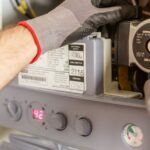
It lights. Then it quits.
A furnace that fires for a few seconds and shuts down is usually failing a safety check, not failing to ignite. That check is the flame sensor doing its job.


 Licensed technicians
Quick answer
A furnace flame sensor is “a small safety device that detects whether a flame is present in your furnace’s burner assembly.” When it cannot confirm combustion, “it shuts the furnace down to prevent gas buildup.” So a furnace that lights and dies within a few seconds is usually being protected, not broken. Treat the sensor as licensed work and never bypass it.
Key takeaways
- Lighting then stopping after two to five seconds is the classic pattern.
- The sensor proves a flame exists, so gas never flows without one.
- Repeated failed attempts end in a lockout that needs a reset.
- Carrier advises professional service for internal parts like this one.
- Above all, never bypass, disconnect or defeat the sensor.
What a furnace flame sensor does
First, the job itself. The sensor sits in the burner flame and confirms that gas is actually burning.
Specifically, it works through flame rectification. A small current passes through the flame, and the control board reads that current as proof of combustion.
Therefore the logic is simple. No current means no flame, and no flame means the gas valve must close.
Older furnaces prove the flame a different way, with a standing pilot and a thermocouple. Our guide to the furnace pilot light in Crown Hill covers that arrangement.
Carrier describes the outcome plainly. If the sensor “cannot confirm combustion, it shuts the furnace down to prevent gas buildup.”
In other words, the part that frustrates you on a cold morning is the part keeping unburned gas out of your house.
How a failing furnace flame sensor behaves
Secondly, the symptoms. Carrier lists a tight set of them, and homeowners describe them almost word for word.
Above all, the most common one is abrupt. “A dirty or faulty flame sensor is one of the most common reasons a furnace starts but then shuts off after a few seconds.”
Next comes repetition. The furnace tries again, fails again, and cycles on and off in quick succession.
Meanwhile the igniter may glow perfectly. You get ignition and still no heat, which sends many people hunting the wrong part.
Eventually the board gives up. After repeated failed attempts the furnace locks out completely and needs a manual reset.
However, one caution belongs here. Carrier notes that a flame sensor is only one possible cause of these symptoms.
| What you observe | What it points to |
|---|---|
| Fires, runs 2 to 5 seconds, stops | Classic flame sensing failure |
| Igniter glows but no sustained heat | Ignition fine, flame proof failing |
| On and off in quick succession | Short cycling, several possible causes |
| Hard lockout needing a reset | Repeated failed ignition attempts |
| Fault code on the control board | Read it, then quote it to the technician |
| Any smell of gas | Leave now, call from outside |
Why the sensor stops reading the flame
Thirdly, the cause. Combustion leaves a fine residue on the metal rod over a season of running.
In effect, that film insulates the rod electrically. The flame still burns, yet the current can no longer pass cleanly.
Consequently the board sees no flame and closes the valve. Nothing is broken in the ordinary sense, and nothing you can see looks wrong.
Besides, position matters. A rod sitting slightly out of the flame reads intermittently, so the fault comes and goes with the weather.
Furthermore, combustion problems upstream create the same result. A dirty burner or a restricted flue changes the flame itself.
What you can do, and where to stop
Firstly, check the simple things. Confirm the thermostat setting, the furnace switch and the breaker.
Secondly, change a clogged filter. Restricted airflow trips other safeties and muddies the diagnosis.
Thirdly, note the exact timing and any fault code. Those two details shorten a service call considerably.
Then stop there. Carrier “recommends professional service for internal furnace components such as the flame sensor.”
Above all, respect the one absolute rule. Carrier states it directly: “Do not bypass, disconnect or defeat the flame sensor.”
Finally, if you ever smell gas, leave the building first. Then call your gas utility and a technician from outside, and never hunt the leak yourself.
How annual service prevents the call
Next, the preventive side. Natural Resources Canada recommends “hiring a licensed and insured contractor to do annual pre-season check-ups.”
That visit covers the combustion side properly. The contractor should “check all gas (or oil) connections, gas pressure, burner combustion and heat exchanger.”
As a result, residue and burner issues get caught before January does the catching. A sensor cleaned in autumn rarely strands anyone in February.
Meanwhile filters remain your job between visits. The federal guide puts filter care under do-it-yourself and suggests your contractor show you how.
What this means around Alcona
Alcona is the busiest part of Innisfil, and much of it went up in waves of subdivision building. Therefore a furnace flame sensor fault here rarely arrives alone.
Those neighbourhoods share equipment ages. Consequently the same fault tends to appear across a street within a season or two.
Lake Simcoe weather sharpens the timing. The first hard cold off the lake makes the furnace run long cycles it skipped all autumn.
Because of that, a marginal sensor usually fails on the coldest night rather than a mild one. Booking service in October costs far less than a 2 a.m. call in January.
Repair, or something larger
In short, a furnace flame sensor issue by itself is small work. The part is inexpensive and the visit is short.
Nevertheless, treat a recurring fault as information. A sensor that fails repeatedly often points at combustion or venting rather than at itself.
If the furnace also short cycles, read our guide to furnace short cycling, since sizing can produce a similar pattern. Where the unit is simply old, how long a furnace lasts sets out the replacement question.
If the furnace fires but no warm air reaches the rooms, the fault is on the air side instead. Our guide to the furnace blower motor covers the noises and breaker trips that point there.
Talk to Aire One Barrie
We diagnose the whole combustion chain, not just the part that threw the code. We serve Innisfil and the rest of Simcoe County from our Barrie shop.
- 24/7 emergency service, including weekends and holidays
- Gas work carried out by licensed technicians only
- Pre-season furnace servicing before the cold arrives
- Bonded, factory trained and licensed technicians
Frequently asked questions
What does a furnace flame sensor do?
It confirms that a flame is actually burning at the burner. Carrier describes it as a small safety device that detects whether a flame is present, and says that if the sensor cannot confirm combustion it shuts the furnace down to prevent gas buildup.
Why does my furnace start and then shut off after a few seconds?
That pattern is the classic sign of a dirty or faulty flame sensor. Carrier calls it one of the most common reasons a furnace starts but then shuts off after a few seconds, though other faults can produce the same behaviour.
Can I clean the flame sensor myself?
Carrier recommends professional service for internal furnace components such as the flame sensor. Gas appliance work in Ontario is licensed work, and a mistake here affects combustion safety rather than just comfort.
Can I bypass the sensor to get heat tonight?
No. Carrier states plainly that you should not bypass, disconnect or defeat the flame sensor. Doing so removes the check that stops gas flowing when there is no flame.
How do I stop this happening again?
Book annual pre-season service. Natural Resources Canada recommends a licensed and insured contractor check gas connections, gas pressure, burner combustion and the heat exchanger each year, which catches combustion problems before winter.
Sources
- Carrier, Furnace Flame Sensor — what the sensor is, flame rectification, the start then shut off pattern, lockout after repeated attempts, professional service guidance, and the instruction never to bypass it.
- Natural Resources Canada, Guide to maintaining your home heating and cooling system — annual pre-season check-ups by a licensed and insured contractor, the combustion checks involved, and filter care.